Página 1 de 2
Circuito lubicacion Go Devil

Publicado:
14 Oct 2012, 23:23por vladimirsinisi
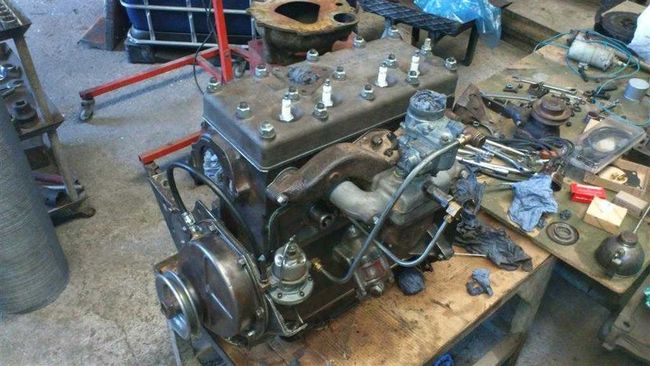
vladimirsinisi escribió:Tambien noten como esta conectado el circuito de aceite

esta directo sin pasar por ningun filtro
Por que hicieron esto???

GRACIAS!!!!!
aca encontre un post en G503 donde se ve el mismo circuito de aceite
Publicado:
14 Oct 2012, 23:28por m606paz
El flexible que va al filtro lo conectaron directamentea la entrada de la tapa de distribucion... tal vez para poner en marcha y devolver el aceite al carter...

Publicado:
14 Oct 2012, 23:30por vladimirsinisi
Publicado:
14 Oct 2012, 23:32por ecn1960
Si, era una redundancia de lo escrito por Felipe, no aportaba mucho.
Saludos
Publicado:
14 Oct 2012, 23:37por m606paz
ecn1960 escribió:Si, era una redundancia de lo escrito por Felipe, no aportaba mucho.
Saludos
A esto se referia Felipe y Enrique

Left to right
-Original MB/GPW chain drive
-Aftermarket replacement for chain drive
-Post war for gear drive
Como se ve el engranaje de la bomba de la derecha es diferente al de las otras dos...
La 3° es de civil con distribucion por engranaje, las otras dos a cadena..
Eso no quita que intercambies engranajes y puedas usar cualquiera de las bombas, la de Guerrero ó la de Civil..
Publicado:
14 Oct 2012, 23:55por vladimirsinisi
CLARISMO!!!
Que buena foto!
Habran cambiado el engranaje o toda la distribucion?
ahora voy a tener que abrir para chusmear

no lo queria abrir pero aunque sea la bomba de aceite voy a sacar para ver y la tapa de distribucion tambien y la tapa de valvulas que tengo que dar vuelta
Publicado:
14 Oct 2012, 23:59por m606paz
Primero intenta girar el cigueñal y ver como gira el arbol de levas, sin desarmar....
Publicado:
15 Oct 2012, 07:29por ecn1960
El mecanico del cual aprendi lo poco que se, le tenia fobia a los filtros de aceite de circuito parcial, no los queria. Cuando Yo arme el ford 100HP Flathead, estuvo una semana diciendo que no le ponga el filtro, como no le hice caso me dijo: bueno, no lo cambie mas y listo

.
Que opinan UDs.
saludos
Publicado:
15 Oct 2012, 18:56por Joe
Con el tiempo supuestamente se filtraría todo el volumen de aceite y mejor que nada es. El filtro bypass fue el primer sistema de filtrado después de una simple malla colocada en el chupador de la bomba de aceite. Va un poco de historia de los filtros de aceite.
ndustry News
Most Read | Most E-mailed | E-mail Article | Print Article
Purolator, Inventor Of Automotive Oil Filter, Leads Industry With String Of Filter 'Firsts'
Purolator Filters
Purolator is the oldest and most trusted name in automotive filtration. From its humble beginnings as the Motor Improvements Company of New York City in the 1920s, it has grown to become Purolator Products NA LLC, a leader in its product category today.
In the beginning, the Motor Improvements Company of New York City was a small company dedicated to making improvements in the automobile. However, when Ernest Sweetland and George H. Greenhalgh invented the first automotive filtration system in 1923, and subsequently licensed it to Motor Improvements, they turned the tide in the company's favor. Sweetland and Greenhalgh named their invention 'Purolator,' short for Pure Oil Later.
The young automotive industry noticed how this invention produced the need for fewer oil changes, maintained cleaner oil in the engine and reduced engine wear. Very soon, Purolator began to be installed on several new cars and Motor Improvements, which began manufacturing the product in a New York City garage, changed its name to Purolator Products.
Ever since, Purolator has been manufacturing, marketing and distributing quality automotive filters to original equipment manufacturers (OEMs) and the aftermarket. A recent agreement with Robert Bosch LLC has made Bosch the joint venture owner of Purolator Filters NA LLC. Today, the Purolator brand includes more than 2,000 part numbers for automotive, light truck and heavy duty applications. In addition, Purolator Filters NA's manufacturing plant is 'TS-16949' and 'ISO 14001' registered.
Rich History of Innovation
While on its way to becoming a well-recognized and respected leading brand in its category, Purolator picked up a number of important 'firsts.'
·1923: Purolator developed the first automotive oil filter.
·1937: Purolator developed the first paper filtration media with filter replacement capability.
·1943: Purolator developed the first 'Full Flow' filter capable of filtering 100 percent of an engine's motor oil. This led to the Full Flow lubrication system used today.
·1946: Purolator invented the Micronic Paper Filter Element - the first pleated paper oil filter. Prior to this, the filter's media was made from cotton waste material. Micronic filtration media can trap even the smallest particles of dirt.
·1955: Purolator developed the first 'spin-on' oil filter. Earlier filters were of the cartridge type design that had to be placed into a type of housing or canister.
·1960s and 1970s: Purolator developed filtration products for transmission fluids, power steering fluids, hydraulics, coolants, crankcase emissions, and other liquids and gases.
·1996: Purolator introduced PureONE - 'the very best oil filter on the market today.'
Publicado:
16 Oct 2012, 16:48por ecn1960
Interesante lo que subiste Felipe, no sabia que los filtros eran tan antiguos y la marca Purolator tampoco.
En cuanto al concepto de flujo parcial opino igual antes que nada...................a la larga filtra.
Saludos
Publicado:
16 Oct 2012, 18:46por Joe
Yo también desconocía la antigüedad de los filtros. Interesante el origen del nombre Purolator.
Publicado:
16 Oct 2012, 19:21por vladimirsinisi
muy bueno!! para entender el sistema bypass, seria el que tengo instalado en mi motor?
Publicado:
16 Oct 2012, 19:44por Joe
Básicamente hay dos sistemas de filtrado. En derivación (bypass) y flujo total. El sistema bypass deriva hacia el filtro una parte del flujo enviado por la bomba mientras que resto, creo que la mayor parte, es enviado a lubricar bancadas y bielas. En el caso del flujo total todo el caudal enviado por la bomba a lubricar los diversos componentes pasa antes por el filtro. El Jeep, al igual que la mayoría de los vehículos antiguos tiene el sistema bypass. Espero que esto aclare tus dudas. Saludos.
Publicado:
16 Oct 2012, 22:36por modelmb
Estos comentarios sobre el funcionamiento del filtro de aceite me hicieron recordar algo que lei en All-american Wonder de Ray Cowdery y que me llamó muchisimo la atención, a continuación paso a transcribirlo:
It´s my feeling that nothing much has ever been right with MB/GPW oil filter or any bypass type oil filter. First, they have an efficiency that´s so low that it´s hard to measure, they don´t filter very much oil. Second, and most important, they actually prevent lubrication. Here´s how. The oil is carried to the front of the block, and it is returned to the crankcase by gravity feed through the timing chain cover.
In plain fact, the oil is taken from the very same gallery that feeds oil to the number 1 main bearing, which in turn feeds oil to the number 1 rod bearing. Given high temperatures and/or high loads there just isn´t enough oil to go around, so the number 1 main and rod bearing run dry.
At best you scrap the crankshaft or a rod and in many cases it is the whole block. Why take that chance? You can´t leave the filter assembly off a restored jeep, but you can block off the filter inlet line (with a small ball bearing, for example) either at the block or where it enters the filter. And no one but you will ever know if it functions or not. The oil filter is a comforting concept for people who don´t maintain their vehicle. On a well maintained restoration it´s a risk no one needs to take.
Siempre luche contra los mecanicos que creen saber más que el fabricante y cada vez que reparan algo dejan fuera un montón de piezas "inútiles" pero el texto es muy tajante en cuanto a la inutilidad o lo que es peor, los perjuicios que produce el funcionamiento del filtro de aceite.
Publicado:
16 Oct 2012, 22:50por Joe
Hola Eduardo, estoy de acuerdo con el tema de los mecánicos inventores pero no me termina de convencer lo que dice el articulo. Creo si la presión de aceite es la adecuada, el aceite debe llegar a todos los puntos a lubricar por igual. No termino de entender porque la bancada 1 debería quedarse sin lubricacion. Saludos.
